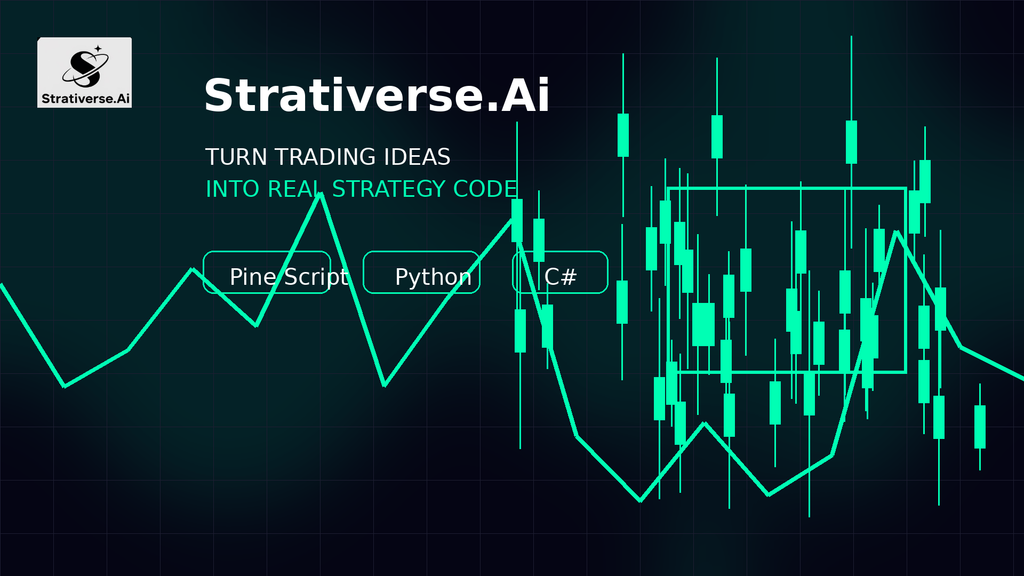
Every automated trading strategy begins with an idea. A trader might recognize a recurring price pattern, identify a useful combination of indicators, or develop rules for entering and exiting particular market conditions. The challenge often appears when that idea needs to become a functional automated system. Strativerse.Ai introduces an AI-assisted approach designed to make this transition faster and more accessible. By simplifying strategy development, testing, and refinement, Strativerse.Ai helps users turn trading concepts into structured automated strategies without making technical complexity the center of the process.
Traditional algorithmic trading development can involve significant programming work. Even when traders know exactly how they want a strategy to behave, converting those instructions into code may require specialized technical knowledge. Programming errors, debugging, configuration, and repeated revisions can extend development timelines. Strativerse.Ai aims to reduce these barriers through artificial intelligence and a streamlined development workflow.
The process begins with strategy logic. Traders typically need to define conditions that determine when a system should act. These conditions may involve price movements, technical indicators, trends, momentum, or other measurable signals. Strativerse.Ai helps users concentrate on these strategic elements rather than requiring them to devote most of their attention to repetitive technical implementation.
AI-assisted development can also improve the speed at which ideas become testable. A trader may have several concepts worth exploring but limited time to build each one manually. Strativerse.Ai reduces development friction, making it more practical to investigate multiple strategies and determine which ideas deserve additional research.
Testing is a critical step when transforming a trading vision into automation. A strategy that appears logical in theory can behave unexpectedly when evaluated using historical conditions. Strativerse.Ai supports a workflow where traders can examine strategy behavior and identify potential weaknesses. Results can then inform decisions about whether rules should be adjusted or the concept should be reconsidered.
Iteration becomes especially important during this stage. The first version of a strategy may need changes to entry conditions, exit logic, indicator settings, or risk parameters. Strativerse.Ai makes repeated refinement more manageable by reducing the technical workload associated with modifying automated strategies. This can allow traders to focus on improving their ideas instead of repeatedly rebuilding code.
Speed can also matter when market conditions evolve. Financial markets can transition between trending, volatile, and relatively stable periods. A strategy designed around one environment may require modification as conditions change. Strativerse.Ai gives users a framework for adjusting concepts and testing alternative approaches more efficiently.
Accessibility is another important aspect of AI-powered strategy development. Algorithmic trading has traditionally been associated with programmers, quantitative specialists, and institutions with extensive technology resources. Strativerse.Ai seeks to lower this barrier by making automation more approachable for traders who understand markets but may have limited software development experience.
Experienced developers can also use greater efficiency to their advantage. Even skilled programmers spend time writing standard components, debugging routine problems, and making repetitive modifications. Strativerse.Ai can help streamline these stages, potentially giving experienced users more time to concentrate on advanced strategy design, research, analysis, and optimization.
A connected workflow can further simplify the journey from idea to automation. Traders sometimes use separate systems for coding, testing, refinement, and implementation. Moving between different tools can interrupt development and introduce additional complexity. Strativerse.Ai focuses on bringing important stages closer together so users can progress through the strategy lifecycle more efficiently.
Turning a trading vision into an automated system does not guarantee that the resulting strategy will be profitable. Strativerse.Ai can simplify development and testing, but markets remain uncertain and automated strategies can generate losses. Historical performance cannot guarantee future outcomes. Appropriate risk controls, realistic assumptions, monitoring, and independent judgment remain essential parts of responsible strategy development.
Automation should therefore be viewed as a way to execute clearly defined rules rather than a replacement for thoughtful decision-making. Strativerse.Ai helps reduce the technical effort required to implement those rules, while traders remain responsible for deciding which concepts are worth testing and how risk should be managed.
Artificial intelligence is changing what traders can expect from development platforms. Instead of spending substantial time learning complex programming processes, users increasingly have access to technology that can assist with implementation. Strativerse.Ai reflects this evolution by putting AI-assisted development within a practical strategy workflow.
Ultimately, Strativerse.Ai helps narrow the distance between imagination and implementation. By accelerating strategy creation, supporting testing, and simplifying repeated refinement, Strativerse.Ai makes automated trading development more accessible to different types of users. As financial technology continues advancing, Strativerse.Ai demonstrates how a trading vision can move from an initial concept toward automated reality through a faster, more flexible, and increasingly intelligent development process.